

Learning Together Through Feedback and Stronger Collaboration
How do you give feedback? And just as importantly, how do you build receiving feedback into your everyday life? When do you notice yourself becoming defensive, and what conditions help you remain open to another perspective?
Most of us would say that we are interested in self-improvement, whether it’s to get better at a technical skill, accomplish career goals, or simply show up in more supportive ways for others. Yet we are also quick to rationalize or justify our actions when someone offers constructive criticism or feedback that suggests we may not be aligned with those goals. This type of feedback can feel like a threat to who we are.
Many of us want to be the best version of ourselves while simultaneously being community-minded. When we hear that we aren’t showing up that way, it can feel contradictory to who we believe we are. We often want to work toward that “best version,” but on our terms, without others sharing their perspectives. In community collaboration, this can be especially difficult when we’re working with others who are equally invested but have experiences that differ from our own.
A recent experience reminded me just how complicated feedback can be, both to give and to receive. I’ve had some calf pain whenever I went for a run. I went to a physical therapist, who is also the owner of the practice, and after five sessions she correctly diagnosed the issue, gave me some strengthening exercises, and sent me on my way. But each session was not a great experience. She would pass me off to an intern (while she bought Girl Scout cookies or took personal calls), tell me reasons she hadn’t responded to my emails, or ask things like, “Remind me what you’re here for?” or “What exercises did I have you do last time?”
I finished my treatment healed but stuck on the idea that she could run her business better if she made a few small adjustments. Was it my role to give her that feedback? And if so, would she be open to it? I genuinely wanted the business to succeed, but I didn’t want to create conflict. For me, whenever someone says, “Can I give you some feedback?” I say “Yes,” but I’m usually bracing for something I don’t really want to hear.
In collaboration, it is best practice to work alongside people with inherently different lived experiences from our own. Built into this reality is the fact that everyone will come to the table with unique, and sometimes conflicting, ways of approaching an issue. That can feel threatening, personal, or confusing if we’re focused only on ourselves. But it can also feel liberating and become a learning opportunity when we are focused on what might ultimately be best for the community.
Collaboration often breaks down when we dig our heels in and prioritize our own agenda over shared learning. Others’ perspectives are quickly dismissed, often with the assumption that their approach is wrong or misinformed. Yet collaboration succeeds when we see these differences as strengths. When someone offers feedback or challenges our approach, those are exactly the moments when we should remain curious and open to different perspectives and allow the strength of diverse ideas to produce the best solutions.
Being open doesn’t mean our opinions aren’t valued or that our approach doesn’t matter. Instead, it reflects confidence in what we believe by demonstrating that we can look beyond our own self-interest or pride and consider a different approach, even one that may not initially align with our thinking.
Next time, instead of asking the generic question, “Do you want feedback?” or “Can you give me feedback” consider making it more specific and framing your questions with curiosity. Here are a few prompts to consider within a collaborative setting.
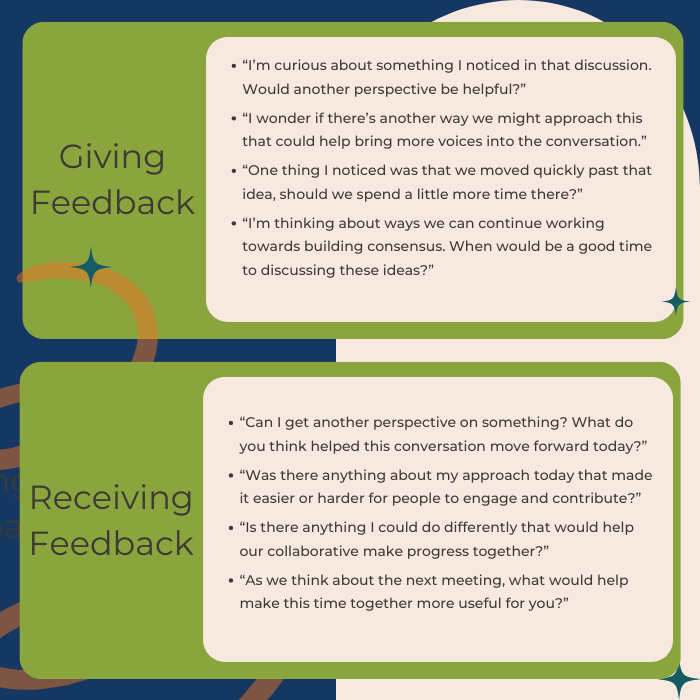
Small practices like this help create a culture where learning, curiosity, and shared responsibility become part of how the collaboration operates. And what is especially great about all of these questions, is that they can be asked to and from anyone in the collaborative, regardless of their position or title. You don’t need to be the running a meeting or “at the front of the room” to work towards making the group stronger.
Collaborative leadership is not a destination; it’s a lifelong journey of self-discovery, self-reflection, and visioning with others. It’s a unique type of leadership that emphasizes catalyzing, convening, and facilitating others to follow a similar journey for themselves. When done well, giving and receiving feedback can make us all better at who we are and what we do. In collaboration with others, opportunities for feedback are simple but powerful tools that help us communicate more effectively and foster personal growth.
It is a natural response to not be open to feedback. Recognizing that can help people in a collaboration learn to give and receive criticism in ways that encourage reflection rather than resistance. In the end, collaborative leadership isn’t about always being right, it’s about staying curious enough to keep learning from the people around us.