
Our Story
Before launching Liminal Collaboration, we worked together for nearly 15 years within partner organizations, helping local organizations bring people together to address the issues they cared about the most, whether it was health, education, community development, and beyond. We saw that meaningful progress depended on how people worked together.
This realization came into focus during our work in the Dan River Region, a rural but growing region made up of several neighboring communities, where we helped build a region-wide health collaborative. We discovered that collaboration was doing so much more than solving one problem. It was creating a lasting community capacity that could strengthen efforts across many issue areas and endure long after individual projects ended.
This experience led us into a deep period of research, reflection, and learning. We listened closely to people in communities and explored what makes collaboration succeed across sectors. What grew out of that research was a 10-month learning cohort implemented over four years and across six cohorts, supporting local leaders to launch, grow, and sustain their own collaborative muscles to be catalysts for meaningful change.
As interest in this work expanded, we founded Liminal Collaboration. Our goal was simple. To walk alongside communities and partner with funders who share our mission and vision for collaboration, helping build the partnerships, trust, and capacity needed for lasting transformation. Today, we continue to learn alongside each community we serve and continually refine our approach, bringing together years of practice, research, and shared learning to help build the collaborative capacity needed to solve complex challenges together.
Our Approach
We approach our work with humility, care, and also a deep respect for the lived experience of community members. Our focus is on the collaborative process, which includes supporting leaders and groups to work across differences, build relationships, and drive systemic change.
Over the past three decades, we’ve supported communities in reducing gang violence, improving maternal health outcomes, building a healthier environment, and strengthening early childhood systems. Our methods evolve with each project, shaped by the unique context and voices of those involved.
What sets us apart is our commitment to co-design, and our focus on practical tools that support action. We emphasize learning, reflection, and continuous improvement, always asking – Is our collaboration leading to the outcomes we hope for?
Our Logic Model
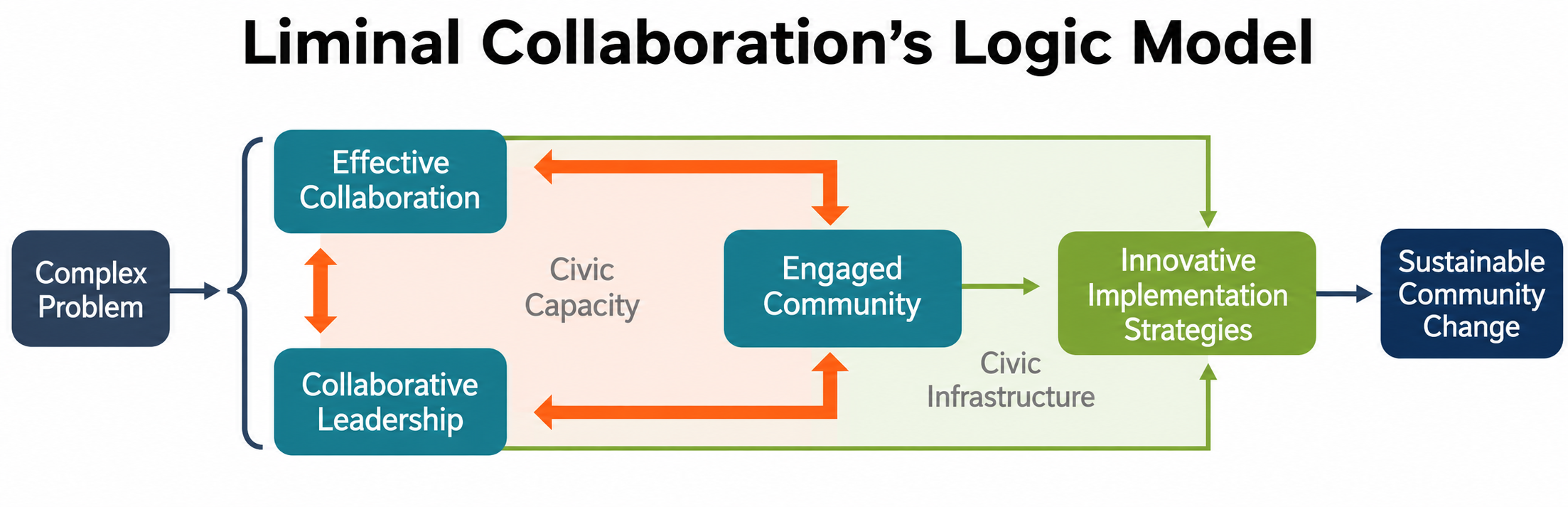
Our work is guided by a research informed logic model that reflects both evidence and our on the ground experience. It helps us and our partners understand how meaningful change happens through collaboration.
We start from the belief that complex community challenges rarely have a one size fits all solution. When leaders, organizations, and collaborative groups work together, they strengthen the civic capacity and civic infrastructure needed to address these challenges effectively.
Liminal Collaboration supports communities in bringing people together, co creating innovative ideas, and implementing strategies that lead to long term, sustainable change.


Liminal Collaboration Equity Statement
Liminal Collaboration believes deeply that everyone is a learner, and everyone is a teacher. Including racially and culturally diverse experts with lived and learned experiences to solve problems is vital to making the greatest impact. Liminal Collaboration practices what we preach, and we are committed to building a team and complementing our (personal and professional) experience with those who reflect the populations most impacted by the very systems we know need changing.
Liminal Collaboration is in a constant state of learning, striving for equitable decision-making, and working against cultural norms that intentionally or unintentionally undermine one’s personhood. We emphasize power sharing by applying adult learning techniques and peer-to-peer support to lift up the diverse and collective wisdom of groups.
We will strive to always include diverse voices, specifically from marginalized populations who have been historically overlooked, including those in deeply rural settings, older adults, BIPOC, people with disabilities, people with language barriers, LGBTQ+, and low-income families). If this value is upheld throughout the process and in all areas of an initiative, we believe it is more likely to be effective and sustainable; Liminal Collaboration and the community will learn more; and local capacity will deepen in expected and unexpected ways.