

The Art of Letting Go (While Still Moving Forward)
I won’t say I have a green thumb, but I do dabble in raising house plants. I can name about one third of the ones in my home. And it’s not uncommon for me to move them around, like furniture, to see if they thrive better in different rooms and lighting. I’m sure the internet would give me advice, but I like the trial-and-error approach. I’ll even re-pot them every so often and mix up different soils to see what happens. I have been known to “borrow” clippings from vacation spots to plant when I get home as a way to bring a piece of the trip home with me. Clearly, I live life on the edge.
Recently a Zanzibar Gem plant (I had to look up the name for this post), which is known to be indestructible, had a whole stalk that was dying. I took notice and tried to revive it. After about six weeks, I finally realized that that part of the plant was done, so I cut it off. But what happened next is what fascinated me: about four new off-shoots emerged through the soil within ten days. Holding on to the failing stalk was presumably not allowing for newness and undiscovered potential to emerge. What if I would have let the dying stalk go sooner? Those fresh buds were at the ready just below the surface, but they needed room to grow. How often do we continue to pour resources into what is no longer working which gets in the way of what could bloom?
Sometimes the thing (i.e., program, funding source) we’re holding on to is actually what is keeping us from growing, from innovating, and ultimately, from supporting the community in the best possible way. The community is ever-changing, and perhaps the routines, partnerships or structures we took care to build have outlived their original use. As Annie put it in her recent blog post, “Sustaining What Matters...”
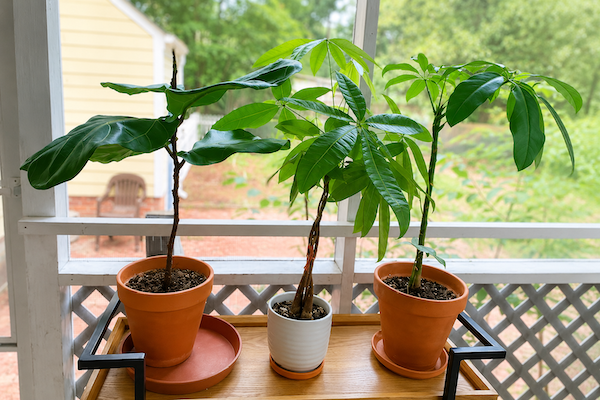
A colleague’s houseplants
enjoying a seasonal move
to the porch, a small
reminder that sometimes
growth comes from trying
a new spot, a new light, or
a little more room…
I have a close friend who is the executive director of a nonprofit. Over the years the organization grew to support seven programs and 18 staff to support community needs, but the funding model showed that in recent years there were fewer funders interested in their work. More “competition” within the region emerged, which was making it harder to maintain the quality work they were doing.
In late 2025, the board made the tough decision to gracefully sunset the organization. Together with partners, they made a plan and are currently finding new homes for their essential programs, phasing out others, and ensuring that clients and staff have ample notice so they, too, can plan accordingly. It’s not gone perfectly, and there were likely hurt feelings and a sense of grief from different stakeholders. But in my opinion as an outsider looking in, this is a good example of “sustaining what works” that we often don’t want to talk about. They protected what was crucial by finding the right home for it, while letting go of what wasn’t.
And for my friend? There was anxiety AND relief in the decision. By thoughtfully determining the fate of the organization in collaboration with the board and other community stakeholders, his leadership - even in this time of sunsetting - showed dignity, transparency, and respect for the work and the people involved. While the organization is not continuing, the good work is.
We are living in a time where uncertainty is a given, and funding sources, particularly public funds, can dry up for reasons that can defy logic. In these times, as Annie pointed out, there’s a tendency towards scarcity. Organizational decisions start focusing more on keeping the organization or project going rather than on how it will impact those who are served.
It’s often subtle but can shift the focus from “we” to “me.”
In such times, organizations put up walls and hide their vulnerabilities as a way to showcase (only) what’s good. A quiet pivot from serving the community to protecting survival. All of this is perfectly normal, as instincts to persist are strong. But these are exactly the times when true, authentic collaboration is necessary.
Authentic collaboration is a way of working together where people come together around a complex community problem that needs solving. Not because there’s a new RFP or because of opportunistic motives. Collaborators lead with their passions, vulnerabilities, and uncertainties - but also hope - to find a better shared outcome. Trust is built through follow-through, consistency, and attention to the importance of relationships.
We continue to think about key differences between sustaining a collaborative and sustaining the strategies it carries. This distinction reframes the question of "how do we keep this going?" My friend's nonprofit is almost a case study in exactly that distinction. The organization and the seven-program structure didn't survive. But the strategies did: the programs found new homes, the clients kept their services, the community kept what mattered. Letting go of the container is what let the content survive.
That's the harder version of authentic collaboration. It's easy to collaborate when everything is growing. It's much harder, and much more necessary, when the honest answer to "what should we hold onto?" is "not this, not in this form." Our present climate of uncertainty and the scarcity of financial resources tempts us to protect the shape of things rather than the purpose of things. But like the Zanzibar Gem, what's actually alive in an organization is rarely the stalk we’ve been nursing. It's already pushing up through the soil, trying to make room for what’s next.
So maybe the question isn't how do we keep this going. It's what deserves to keep going, and whether we're willing to let go of everything else to protect it.