
Unveiling Liminal Collaboration’s Logic Model: Why Our Work (Actually) Works
There is nothing more exciting than reading about an organization’s logic model! Okay, maybe that’s not true. But here it is: the post that you never knew you wanted or asked for.
We are forever curious at Liminal Collaboration (ask us about our burgeoning book club!), which means we ask a lot of questions. The head-scratcher kind. The unanswerable kind. And the ones that require more data, evidence and experience. Some of those include:
How does a culture of collaboration lead to equitable outcomes in critical areas?
Can successful collaborative groups only happen if there are strong leaders or is it the other way around?
What are the chances that innovative community-level strategies stick without collaboration?
How can funders make wise investments in collaboration if they are interested in sustainable community change?
We spend a lot of time with community leaders and funders who are also thinking about these questions. It would certainly be a lot easier to NOT work collaboratively and NOT fund collaboration but rather just work on implementing strategies alone. It makes sense. There’s more control in trying it that way…although time and time again, organizations that don’t work in collaboration, fail to see results.
I just got off a phone call this morning where a non-profit partner made unilateral decisions without consulting others in the collaborative that resulted with the non-profit partner spending thousands of dollars on resources that were available to them for free had they just communicated better. This weakened the collaboration, eroded trust, and also felt like squandered funds. When these breakdowns happen, they ultimately harm community members who need supports.
Community issues are complicated. Coming together collaboratively to solve those issues is also complicated. They are both messy, interconnected, and shaped by history, experiences, and sometimes by whoever forgot to reply-all on an important email. But complexity doesn’t mean we shouldn’t collaborate. It’s exactly why we built our new logic model.
At its core, our logic model is a roadmap for what it takes to make real, lasting community change. It starts with a truth many of us know all too well: no single organization can fix a complex problem alone.
When complex problems have many variables and no one “right answer,” it’s time for collaboration. Not this performative kind like “let’s meet every month and share updates” type, but the deep, adaptive, roll-up-your-sleeves and build something together kind, that leads to more meaningful impact. This logic model serves as a reminder that progress doesn’t come from magic; it comes from conditions we intentionally create.

Liminal Collaboration’s Logic Model
If communities acknowledge the complexity of their challenges, then they understand collaboration isn’t optional. It’s essential.
If collaboration is working and leadership is shared, then residents become more engaged and invested in shaping solutions that affect their lives.
If communities reach this level of engagement, then civic capacity grows and people actually know how to get things done together.
This isn’t just theory. It’s a practical tool for resident leaders, professionals, and other decision makers who work in the, ahem, liminal spaces between sectors, agencies, turf, and agendas.
The logic model helps you diagnose where a collaborative effort is stuck, what capacities are missing, and what investments can make a difference.
Complex problems don’t scare us (much). And the concepts in this logic model aren’t about reinventing the wheel. But it is intended to show a roadmap that might help collaborative groups identify where their community is on the journey around a certain issue and offer some ideas on how to best address it. It is intended to turn collective effort into collective progress to sustainable community change.
And as we circle back to the questions we opened up with, we know the real challenge isn’t refining the concepts, it’s understanding the how. How groups share leadership, how trust is built, and how collaboration becomes more than a meeting. That is the nuance our work focuses on every day. Helping partners navigate the “how” so meaningful change can actually take root.
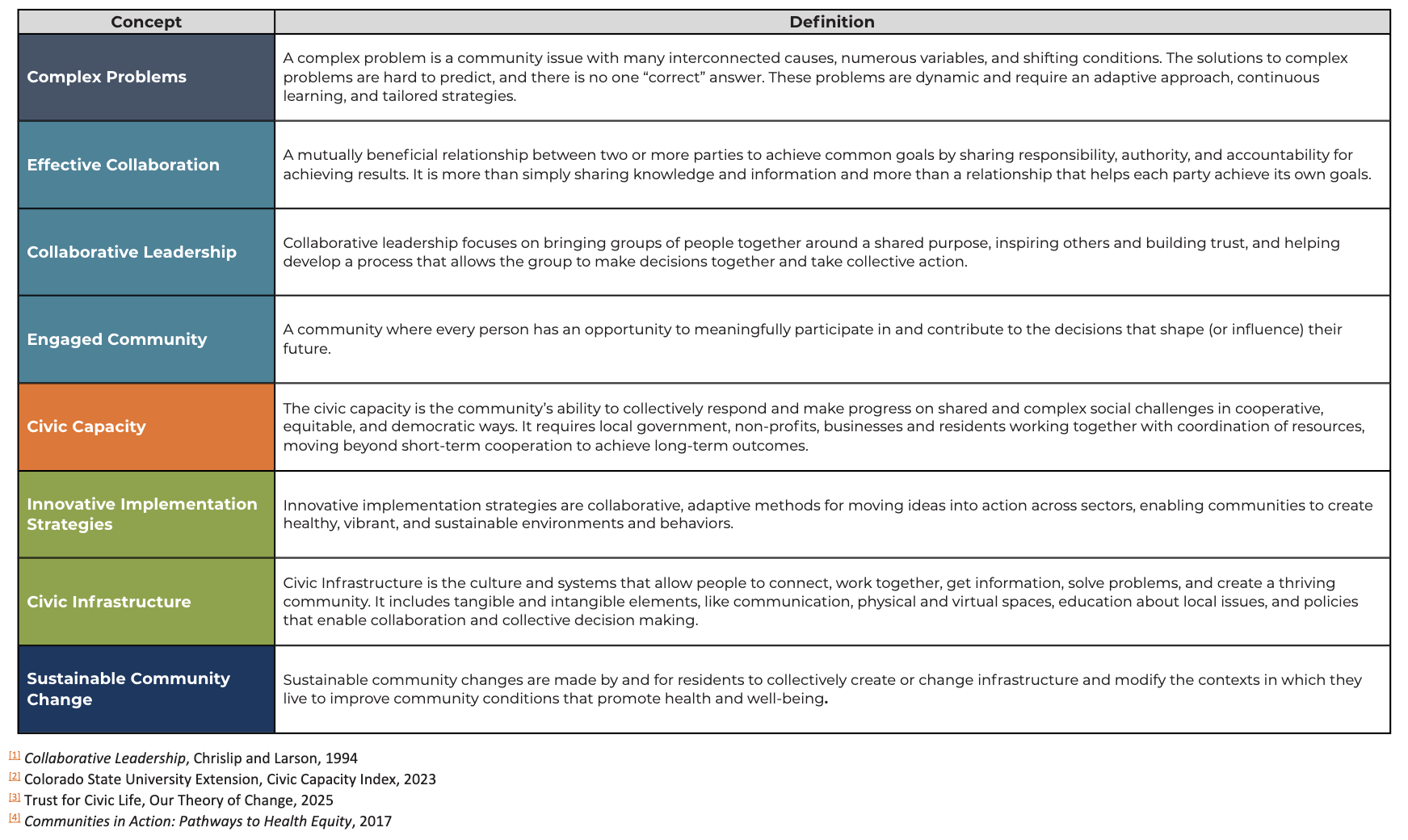
Key Concepts and Definitions in Collaborative Leadership and Community Change